EMEP European anthropogenic emissions
EMEP emissions have been superseded by CEDS global emissions.
On this page we provide information about The Co-operative Programme for Monitoring and Evaluation of the Long-range Transmission of Air Pollutants in Europe (EMEP) anthropogenic emissions inventory for Europe.
Overview
The EMEP inventory includes annual anthropogenic emissions of CO, NH3, NOx, and SOx for 1990-2005. This inventory also includes emissions of CO, NH3, NOx, and SOx from ship exhaust.
The data files were obtained from the EMEP website and processed by Aaron van Donkelaar.
In GEOS-Chem v10-01 and newer versions, the EMEP anthropogenic and ship emissions are read with the HEMCO emissions component. We have created new EMEP data files (in COARDS-compliant netCDF format) for use with HEMCO. These new data files are contained in the HEMCO data directory tree. For detailed instructions on how to download these data files to your disk server, please see our Downloading the HEMCO data directories wiki post.
--Bob Y. 13:13, 3 March 2015 (EST)
Discussion following 1-month benchmark v10-01h
The 2008-2010 updated EMEP emissions were validated in GEOS-Chem v10-01h. The following discussion ensued.
Aaron van Donkelaar wrote:
- I'm a little surprised at the drop of more than 50% in anthropogenic SO2 and NO over Europe.
- I decided to explore the large drop in emissions and have found the drop in the revised EMEP emissions that are presently available to be much lower in than what EMEP had estimated when I downloaded/reformatted the original dataset back in 2011.
- It should be fairly straightforward for me to reprocess new EMEP input files based on their latest estimates, which run until 2012, if the old format is still useful post-HEMCO.
- For now I would not recommend using the EMEP files originally slated as part of this update. Rather, I would suggest that I/we update the emission based on the latest EMEP inventory.
Update 3/31/15: Aaron has reprocessed EMEP emissions for 1990-2012. Please see this wiki post for more information.
--Melissa Sulprizio 16:40, 27 March 2015 (EDT)
Reprocess EMEP emissions for 1990-2012
This update was validated with the 1-month benchmark simulation v10-01i and approved on Approved 01 May 2015.
The original updated EMEP emissions for 2008-2010 (generated in 2012) were found to be too low in 1-month benchmark v10-01h, so Aaron van Donkelaar reprocessed EMEP anthropogenic and ship emissions of CO, NH3, SO2, and NO for 1990-2012. The reprocessed data file is in netCDF format and includes data that has been mapped from the original 50 km grid x 50 km grid onto a 0.1° x 0.1° grid. Regridding to the finer 0.1° x 0.1° resolution allowed these input files to maintain a reasonable representation of their original grid characteristics, thereby permitting HEMCO to more accurately regrid onto a variety of GEOS-Chem grids. This file is read with the HEMCO emissions component and will be validated with 1-year benchmark v10-01h-Run0.
--Melissa Sulprizio 14:08, 31 March 2015 (EDT)
EMEP European ship emissions inventory
The EMEP inventory contains ship emissions for CO, NH3, SOx, and NOx.
Please also note the following fixes that are relevant for GEOS-Chem v9-01-01 or older versions:
- Bug with EMEP ship emissions for nested grids
- Bug fix for EMEP ship emissions
- Fix for initialization of EMEP ship emissions
- Inconsistent mask file for EMEP ship emissions
1980 to 1989
EMEP ship data from 1980-1989 emit NOx as pure NOx (and not HNO3 + 10*O3). It was not possible to separate the NOx into HNO3 and O3 from this data set.
See Auvray and Bey [2005] and Vestreng and Klein [2002] for more information.
1990 to 2005
EMEP ship data from 1990-2005 are based on Vestreng et al. [2007].
--Bob Y. 12:00, 20 December 2012 (EST)
Known issues
Zero EMEP emissions at 30N
This update was validated with 1-month benchmark simulation v11-01f and 1-year benchmark simulation v11-01f-geosfp-Run0. This version was approved on 16 Apr 2016.
Eloise Marais wrote:
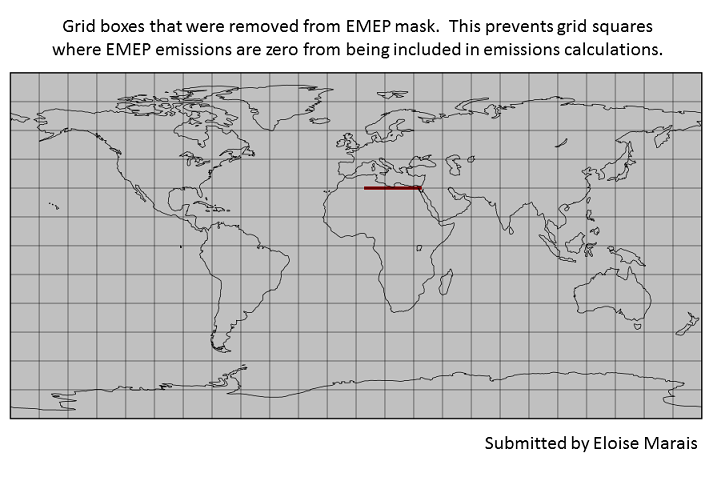
Anthropogenic emissions are zero where the EMEP and EDGAR emissions coincide at 30 degrees North (using GEOS-Chem v10-01). This is because the EMEP mask extends to gridsquares where EMEP emissions are zero. Anthropogenic emissions are relatively low there, so this issue only shows up when NOx emissions are plotted on a log scale.
My quick fix is to shift the minimum latitude of the EMEP mask up by 1 degree latitude (so starting at 31 deg N instead of 30 deg N), in an updated mask file EMEP_mask.geos.1x1.20151222.nc. (The boxes that were removed show up as RED in the plot below.)

As of 06 Jan 2016, the GEOS-Chem Support Team has placed the updated mask file into the following HEMCO data directory:
HEMCO/MASKS/v2014-07/EMEP_mask.geos.1x1.20151222.nc
We will validate Eloise's update with the 1-month benchmark simulation GEOS-Chem v11-01f. This will involve changing the EMEP mask filename in the proper HEMCO_Config.rc files.
NOTE: The old mask file (EMEP_mask.geos.1x1.nc) shall be preserved for backwards compatibility.
--Bob Yantosca (talk) 15:23, 30 March 2016 (UTC)
Observed differences in CO emissions attributed to new EMEP mask file
Note that simulations using the updated EMEP mask file may cause some emissions differences w/r/t simulations using the old EMEP mask:
Prasad Kasibhatla wrote:
I am surprised by the differences in CO emissions between v11-01d and v11-01f. I was struck by how large they seem to be. What first caught my eye was the difference in boundary-layer CO mixing ratios in Cairo - and it looks like it is related to a big change in anthro+bifuel emissions in one grid box....Is there a simple explanation for this?
Melissa Sulprizio replied:
Differences in the anthropogenic+biofuel CO emissions in Cairo were caused by the updated EMEP mask file introduced in v11-01f. Eloise Marais found that EDGAR emissions were zero at 30N because the EMEP mask extended too far south, so she provided a new file that shifts the EMEP mask north by 1 degree.
--Bob Yantosca (talk) 16:01, 15 April 2016 (UTC)
References
- EMEP website: http://www.emep.int/index.html
- Auvray, M., and I. Bey, Long-Range Transport to Europe: Seasonal Variations and Implications for the European Ozone Budget, J. Geophys. Res., 110, D11303, doi: 10.1029/2004JD005503, 2005.
- Vestreng, V., and H. Klein, Emission data reported to UNECE/EMEP: Quality assurance and trend analysis & Presentation of WebDab, MSC-W Status Report 2002, Norwegian Meteorological Institute, Oslo Norway, July 2002. (PDF)
- Vestreng, V., Mareckova, K., Kakareka, S., Malchykhina, A., and Kukharchyk, T., Inventory Review 2007; Emission Data Reported to LRTAP Convention and NEC Directive, MSC-W Technical Report 1/07, The Norwegian Meteorological Institute, Oslo, Norway, 2007. (PDF)
--Bob Y. 12:13, 20 December 2012 (EST)